Free Power of Attorney Forms
Create a legally valid power of attorney in minutes. Choose your state and POA type to generate a compliant document you can download, sign, and store securely.
- Duration 5 min
- Download as PDF and Word
- E-sign included
Create a legally valid power of attorney in minutes. Choose your state and POA type to generate a compliant document you can download, sign, and store securely.
Choose the type of Power of Attorney needed and check state requirements.
Complete guided questions, download the document, and ensure it meets state signing laws.
Distribute signed copies to your agent and relevant institutions while safely storing the document.
Power of attorney laws vary by state, so using an incorrect form often causes delays with hospitals, banks, or government agencies. Using a state-specific power of attorney ensures your document meets state signing and notarization requirements. Select your state below to learn more about your state’s POA laws and start customizing your form to meet your needs.
A power of attorney (POA) is a legal document that allows one person (the principal) to appoint another person (the agent or attorney-in-fact) to act on their behalf.
Depending on what type of POA you use, the agency may be able to:
Without a POA in place, your family may need to go to court to gain authority to help you.
You may need a POA if:
Different types of POAs serve different needs. Choose the one that meets your requirements below:
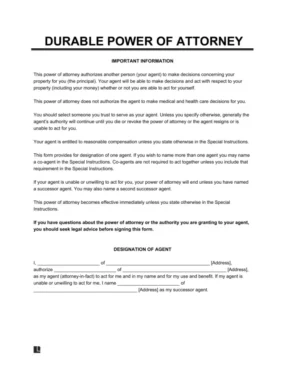
Durable Power of Attorney
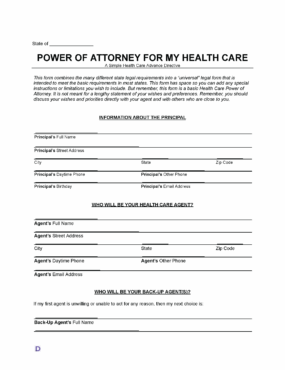
Medical Power of Attorney Form
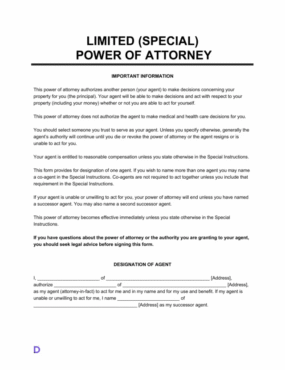
Limited (Special) Power of Attorney
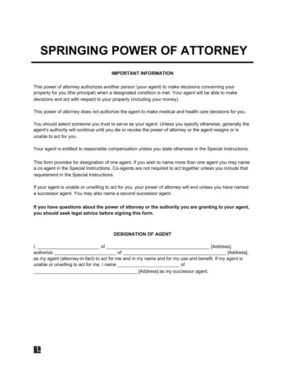
Springing Power of Attorney
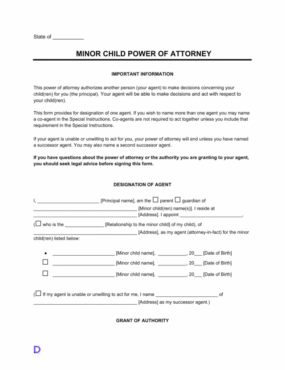
Minor (Child) Power of Attorney
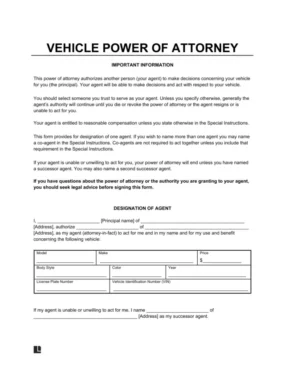
Motor Vehicle Power of Attorney Form
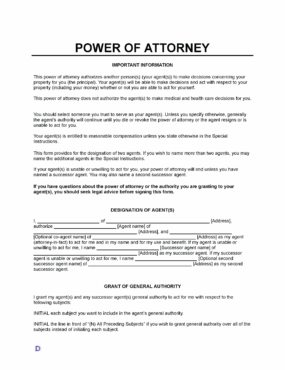
Non-Durable Power of Attorney
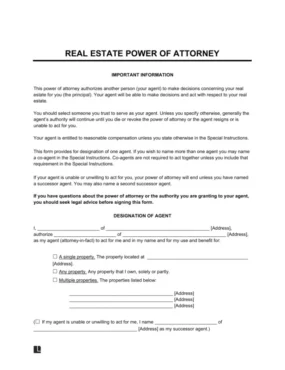
Real Estate Power of Attorney Form
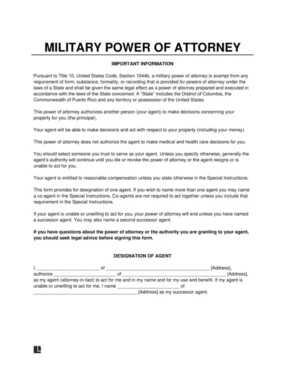
Military Power of Attorney Form
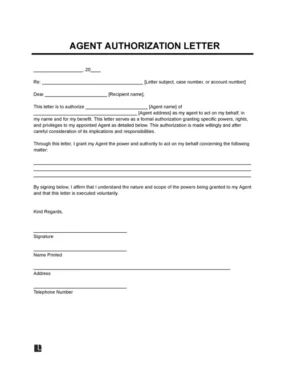
Agent Authorization Letter
Not all powers of attorney work the same way. The right POA for your situation depends on what decisions you want ot delegate, how long you want the authority to last, and whether it should continue if you become incapacitated. Use the table below to help you make the right decision.
| Situation | Recommended POA |
|---|---|
| Planning for illness or aging | Durable POA |
| Medical decision-making | Medical POA |
| Temporary help with finances | General POA |
| One-time task | Limited POA |
| Want authority to start later | Springing POA |
| Temporary child care | Minor POA |
Choosing someone to act as your power of attorney is an important legal decision that requires careful thought and consideration. If you become incapacitated, your POA agent will have the authority to handle financial, healthcare, and other personal matters on your behalf. Before choosing your agent, you should consider the following:
An agent can:
An agent cannot:
A general (financial) power of attorney lets someone you trust manage your money and property if you cannot. With Document Genius’s guided form, this process is simple, clear, and stress-free. Below is a step-by-step overview of what you’ll include and how to complete it confidently.
The principal is the person granting authority. Start by entering their full legal name and current address.
Next, name your agent. This person will manage financial and property-related matters on your behalf. Choose someone you trust completely.
You can also name:
Define what your agent can manage. A general (financial) power of attorney typically covers areas like:
Document Genius’s step-by-step questionnaire helps you avoid missing key permissions.
Some actions require extra, explicit permission, such as making gifts or changing beneficiaries. These are optional but important.
Use the special instructions section to customize how your power of attorney works. For example, you may:
You can decide when the document becomes active:
Most people choose a durable power of attorney, which stays effective even if the principal becomes incapacitated. A regular (non-durable) power of attorney ends if incapacity occurs.
Your selection determines how long the authority lasts. It is also important to check default-state laws to determine whether the document is presumed durable.
To be legally valid, the principal must sign the power of attorney. Most states also require notarization, and some may require witnesses.
Once completed with Document Genius, you can:
Each state has its own rules for how a POA must be signed to be valid. Some require notarization, others require witnesses, or both.
A few things to know:
To be sure your POA is accepted, always check the latest rules in your state or consult a professional for complex cases. Select your state from our state POA forms to learn more about the signing requirements that apply to you.
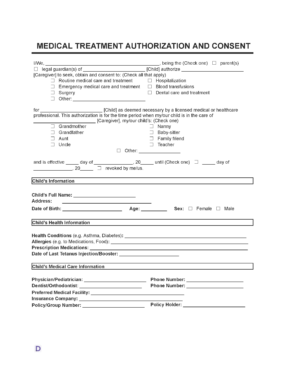
Authorize caregivers to make medical decisions for your child in case of emergencies or when you're unavailable.
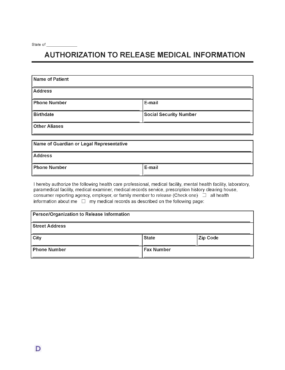
Grant permission to healthcare professionals or organizations to share your medical records.
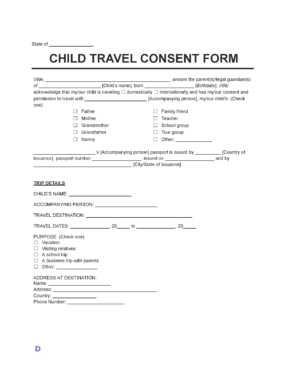
Authorize a child to travel with someone other than their legal guardian, either abroad or domestically.

One place to build, sign, and manage documents.